
Choosing the right welding gloves for TIG MIG is essential for safety, comfort, and welding performance. Different welding processes—TIG, MIG, and Stick welding—require different levels of heat resistance, dexterity, and protection. Understanding these differences helps you select the best gloves for your job. Welding is a craft of fusion, joining metal with intense heat and light. But that same power that creates strong bonds also poses a significant danger to the welder. Standing between a welder’s hands and temperatures that can exceed 10,000°F (5,500°C) is a single, crucial piece of Personal Protective Equipment (PPE): the welding glove.
More than just a glove, it is a purpose-built shield designed for one of the most extreme industrial environments. Its primary mission is straightforward yet vital: to protect the hands and forearms from a triad of hazards—extreme heat, molten spatter, and electric shock.
The Anatomy of Protection: What Makes a Welding Glove?
Unlike standard work gloves, welding gloves are engineered with specific features to handle the unique demands of the trade:
- Heat Resistance: The core function. Welding gloves are typically made from materials with exceptionally high ignition temperatures, such as:
- Leather: The most common material, with different types offering various benefits:
- Cowhide: Durable and economical, good for general-purpose welding (e.g., Stick/MIG).
- Pigskin: Highly durable and breathable, with a natural resistance to moisture and abrasion.
- Deerskin: Renowned for its superior flexibility and heat resistance, offering a great “feel” for precision work like TIG welding.
- Goatskin: Extremely flexible and tough, often used in areas of the glove that require dexterity.
- Elkskin: Thick, insulating, and incredibly heat-resistant, ideal for heavy-duty applications like stick welding or gouging.
- 2. Insulation: Many gloves feature multiple layers, including an inner lining of heat-resistant materials like Kevlar® or wool, which provides an additional thermal barrier without adding excessive bulk.
- 3. Extended Gauntlet Cuff: This is the long, flared sleeve that extends up the forearm. It is absolutely critical for protecting the wrist and forearm from sparks and spatter that can roll down the arm, as well as from the intense radiant heat of the arc.
- 4. Reinforced Palms & Thumbs: High-wear areas are often double or even triple-layered with extra leather to combat abrasion and provide a longer lifespan.
- 5. Dexterity & Grip: While safety is paramount, a glove must still allow the welder to hold an electrode holder, TIG torch, or MIG gun with control. Different glove designs strike different balances between maximum protection and fine-touch dexterity.
How to Choose the Best Welding Gloves for TIG MIG and Stick Welding Jobs
Not All Gloves Are Created Equal: Types of Welding Gloves. The type of welding process dictates the ideal glove:
- Stick (SMAW) Welding Gloves: Typically the heaviest and most robust. They are long, heavily insulated, and made from thick leather like elkskin to handle high amperage, hot spatter, and the physical handling of electrodes.
- MIG (GMAW) Gloves: Similar to Stick gloves but often offer a bit more dexterity. They are essential for handling the spatter produced by the MIG process.
- TIG (GTAW) Welding Gloves: These are the “sports cars” of welding gloves. Made from thin, soft leathers like deerskin or goatskin, they prioritize supreme dexterity and sensitivity to handle small filler rods and make precise adjustments, as TIG welding produces very little spatter.
- Heat-Resistant Gloves (for Cutting/Grinding/Oxy-Acetylene): While not always classified as “welding” gloves, these are essential in a welder’s toolkit. They are designed to protect from radiant heat and sparks during ancillary tasks like grinding or using a cutting torch.
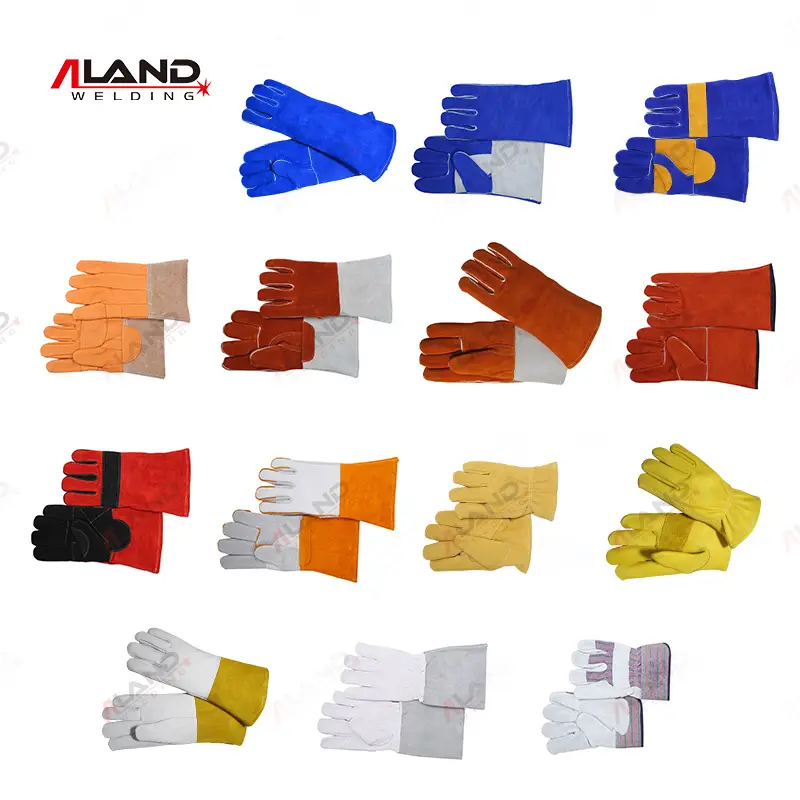
ALAND WELDING offers industrial welding gloves made from various materials and designed for different functions; you can choose the pair that best suits your specific needs.
| Type | Model | Size | weight(g) |
| Multiple MIG/TIG Welding Gloves | WG-0328 | 36*17*1.5cm | 310 |
| Heavy Duty Stick Welding Gloves | WG-0505 | 36*17*2cm | 340 |
| Heavy Duty Stick Welding Gloves | WG-1166 | 36*17*2cm | 340 |
| Heavy Duty Stick Welding Gloves | WG-2900 | 36*17*2cm | 340 |
| Heavy Duty Stick Welding Gloves | WG-2601 | 36*17*2cm | 340 |
| Heavy Duty Working Gloves | WG-2203 | 28*15*1.5cm | 190 |
| Soft & Sensitive Tig Welding Gloves | WG-1099 | 36*15*1cm | 180 |
| Soft & Sensitive Tig Welding Gloves | WG-1111 | 36*15*1cm | 180 |
| Soft & Sensitive Tig welding Gloves | WG-9003 | 36*10*6cm | 400 |
| General Stick Welding Gloves | WG-2054 | 46*17*2cm | 380 |
| General Stick Welding Gloves | WG-2102 | 36*17*1.5cm | 310 |
| Cold Proof Gloves Series | WG-2266 | 36*17*1.5cm | 310 |
| Multifunctional Drivers Gloves | WG-2700 | 28*15*1. 5cm | 190 |
| Hot Valuable MIG Welding Gloves | WG-2855 | 36*17*1.5cm | 310 |
The best welding gloves depend on the type of welding job you perform. TIG welding requires precision gloves, MIG welding needs balanced protection, and Stick welding demands heavy-duty heat resistance. Choosing the right gloves not only improves your welding efficiency but also ensures long-term hand safety in demanding industrial environments.